
US/UK Version Differences: Introduction
Laying the groundwork for my work

Introduction to Version Changes
It’s relatively common knowledge that the C-Cube is described as blue in the US edition and described as red in the UK edition of The Eternity Code. If you didn’t know that, well, spoiler alert for the eventual article where I go over the changes in that book’s editions.
For often unknown reasons in the editing process, some of the content of the books ends up different in the printed US edition vs the printed UK edition. Here, at least initially, I will be comparing the original hardcover text of each. Further revisions (usually spelling & grammar) do occur over the years in later paperback editions, but the highest quantity and most interesting changes are typically found when comparing original US vs original UK text.
I say “often unknown reasons” because sometimes it’s fairly easy to suss out why something might be changed: Censoring risqué references (yes, seriously), continuity fixes, deleting references to specific brand names, etc. You’ll see some of those in these articles, but also some changes that defy explanation, where it feels like the editor needed to change something about the text in order to get paid as an editor and not for any other reason.
I am based in the US and grew up with US editions, but I imagine the UK text is closer to what we could call an “original” or “base” version, even if solely for the fact that Eoin Colfer probably writes measurements in metric first, which then get converted (usually) to inches and feet in US editions of the books. However, I have seen changes in these books that indicate to me that the US and UK publishers edit the manuscript they receive independently, as sometimes an error will be caught and fixed in one region but it’ll slip by in the other region, and it goes both ways. I don’t believe the UK text is fully finalized and then handed off to the US to be edited for American audiences. I believe they’re both edited simultaneously from one starting draft and without consulting each other on the final product, so one version might have errors the other doesn’t. However, when discussing a change, I’ll often say “XYZ thing in the UK was changed to ZYX thing in the US” for ease of describing the text difference.
When discussing a change, I’ll use page numbers, and the page numbers I use will be of the original hardcovers. In most of the various paperback reissues over the years, the text and font size wasn’t changed drastically, so the numbers I’m using will also apply to most paperback editions. However, the new 2018 US paperbacks overhauled how the text flows on the page to save paper by hyphenating more words across two lines of text, so they have less total pages than earlier editions. If you own these editions and want to follow along with me when I reference a page number, you’ll most likely have to flip back to an earlier page a bit to find the section I’m talking about. The page numbers I reference will also probably be useless if you’re using an e-book copy to follow along with me.
Changes to content vs nitty-gritty copyediting
There is a difference in the text on literally every single page of these books, sometimes multiple per page, but the vast majority are little tiny copyedits: regional word spelling, grammar, punctuation, and the like. Many of these involve the presence or absence of commas like in the sentence preceding this one. Different editions’ editors feel differently about where commas should go in sentences to break up the text. If there are any particularly noteworthy changes that alter the actual content of the book (such as when a character’s spoken grammar changes how they come across) I may report on those, but typically, I will refrain from boring you with these sorts of changes.
Here is a demo of some of what I’m talking about using a sample paragraph I’ve annotated:
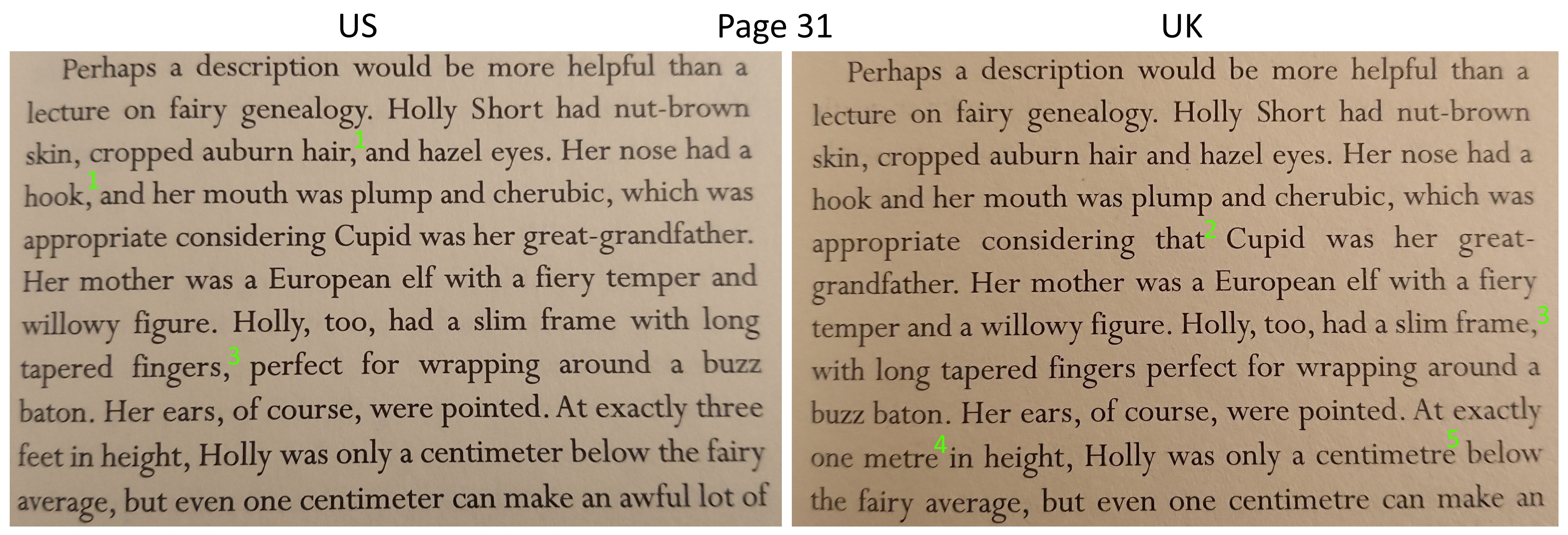
1: Oxford commas. The US edition always has them, and the UK edition always omits them. A curious, perhaps counterintuitive quirk.
2: Miscellaneous trivial copyedit, inserting/omitting the word ‘that.’ I typically won’t report on these when they don’t meaningfully change the content of the story, but rest assured they’re present all over the place, slightly altering the flow of sentences.
3: Not an Oxford comma, but a comma whose location is moved within the sentence to change how it flows. The comma is after ‘fingers’ in the US and after ‘frame’ in the UK. Again, a trivial copyedit I will generally not report on.
4: A Metric conversion. These sometimes actually alter the content of the story if the conversion results in a meaningful difference in how large or far something is. I will be reporting on this one, for instance, as the measurement of ‘three feet’ is over three inches shorter than the measurement of ‘one meter.’ And as the story points out, even one centimeter makes a lot of difference when you’re a fairy. Picturing her height difference with Artemis, who is canonically 5’5” as of book 7, actually changes a fair bit if she’s exactly three feet or if she’s three feet + three inches.
5: Two things of note here. One is that the US does not change the centimeter to anything like an inch, or half an inch. Who knows why. The other thing is that this is an example of a spelling change due to the region. In the US, we spell meter/centimeter like so, but in the UK it’s spelled metre/centimetre. There are tons of these spelling changes throughout, which I will generally not report on.
Sometimes a whole word is different because we refer to things with different terms, which I might report on if I think it’s interesting enough, but generally won’t (unless you guys really want me to!). For example, in book 1, the word ‘gas’ in the US is ‘petrol’ in the UK. Not an earth shattering revision there, but rest assured they’re there.
And now we can begin
Article with book 1’s content changes should be up within a week, now that I’ve established the groundwork here to explain generally what’s going on.
Not every change is as impactful as red vs blue C-Cube, but still, I hope you look forward to it.